Acoustic guitar is where most students start. You learn chords, strumming patterns and fingerpicking, and you get to real songs quickly: a handful of chord shapes opens up hundreds of them.
Electric guitar covers rock, blues, pop and indie. That means lead technique, riffs, scales for soloing, and learning to improvise over a backing track.
Classical guitar focuses on reading music, fingerstyle technique and graded repertoire. See our classical guitar lessons.
Bass guitar builds groove, timing and the foundation every band depends on. See our bass guitar lessons.
Lessons are shaped around the music you actually want to play, not a fixed syllabus.
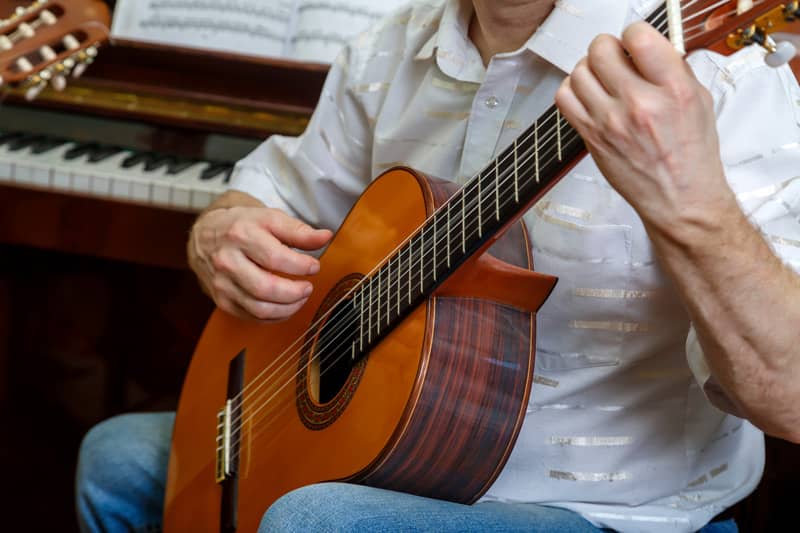
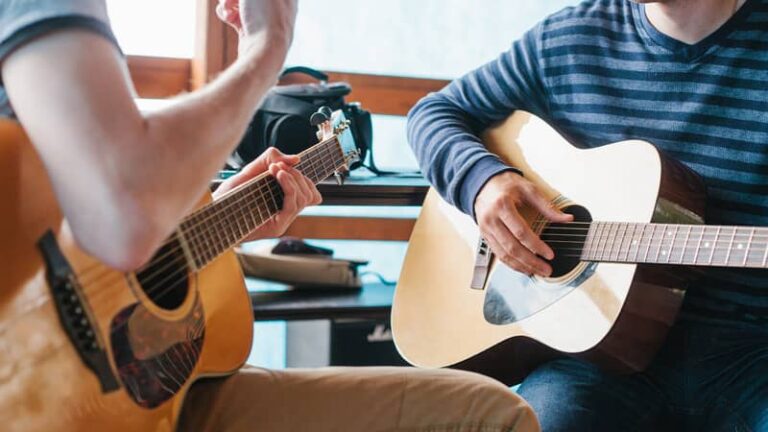
Children usually start guitar from around eight, when their hands can manage the neck. Younger children often begin on ukulele and move across. Is your child ready?
Teenagers learn the songs they love, work towards playing in a band, and can prepare guitar as a performance instrument for Leaving Cert Music. The Leaving Cert Music guide explains how.
Adults come to us as complete beginners, as returners, and as self-taught players who have hit a ceiling. Why you stopped teaching yourself guitar.
Exam students can take graded exams in acoustic and electric guitar. We typically work with Sounds Great and RGT, and other boards are available on request.
Wondering what's realistic? Here's what you can play after a year of guitar lessons.
My daughter has been taking guitar lessons here for years. The teaching is fantastic and she absolutely loves it, and they have been very accommodating with class times, changes etc. Can't recommend them highly enough.
The Dublin School of Music is the perfect place for young kids to explore and develop their love for music. The teachers are not only highly skilled but also multi-instrumentalists, which has been an incredible advantage for my 5-year-old. He has the luxury of trying different instruments—guided by expert instruction—until he finds the one he truly connects with.
The school’s warm, old-worldly charm, combined with a thoughtful and flexible teaching approach, creates a nurturing environment where children can flourish. They make learning fun and engaging while building a solid foundation in music. I highly recommend it for any parent looking for a personal, enriching musical education for their child!
The questions we are asked most often by people thinking about starting.
You can learn a great deal in three months. Most beginners taking weekly lessons can play open chords, change between them smoothly, strum in time, and get through a handful of recognisable songs by the end of month three. What three months will not give you is barre chords at speed or fluent lead playing — those come later in the first year. Here is the full month-by-month timeline.
For most students, yes. A focused 30-minute one-to-one lesson every week gives a teacher time to check technique, correct problems, and set the week's practice — and it matches what a beginner can absorb before concentration drops. Progress depends far more on practising for fifteen minutes most days than on sitting in a longer lesson once a week.
No. Adults in their forties, fifties and beyond make up a large share of our guitar students, and many progress faster than teenagers because they practise with intent and know what they want to play. The physical demands of guitar are modest, and the first few weeks of sore fingertips pass at any age.
If you have tried and stalled on your own, almost certainly. Free videos teach you what to play but cannot see your hands, so bad habits in fretting, posture and strumming go uncorrected and become the ceiling on your progress. A teacher watching you every week fixes those in minutes and chooses what you work on next, which is the part self-teaching rarely gets right. More on why self-teaching stalls.
At Dublin School of Music, guitar lessons are €300 for a ten-lesson term of weekly 30-minute one-to-one sessions, or €27.50 per lesson on our automated payment plan. A three-lesson taster course is €99, credited against your term fees if you continue. Lessons run at our Tallaght, Stillorgan and Terenure schools.