
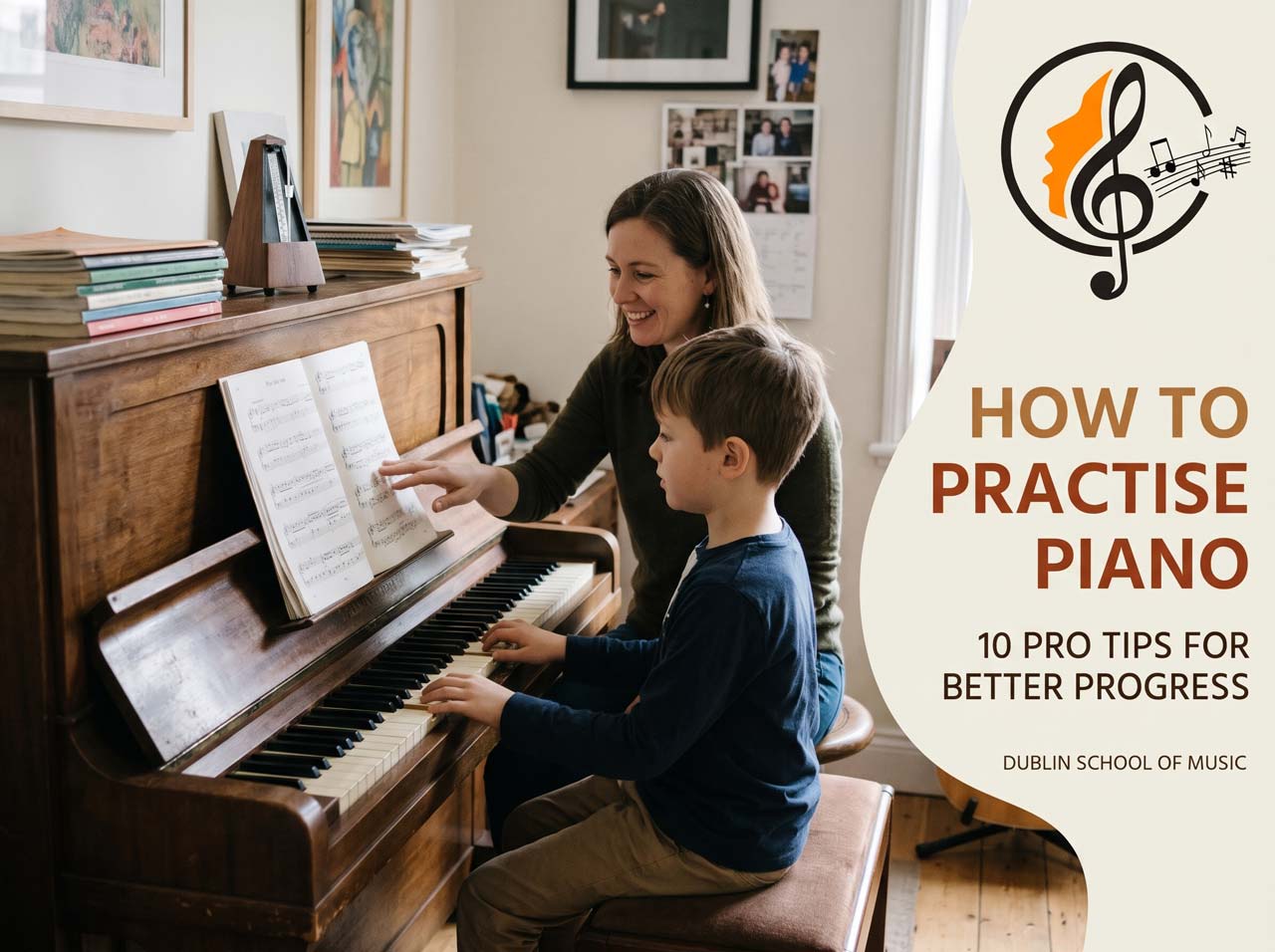
The secret to becoming a better pianist isn’t necessarily practising for longer. It’s learning how to practise properly.
Whether you’re a complete beginner, a parent helping your child with piano lessons, or an experienced pianist tackling a challenging piece, the way you approach practice can make an enormous difference to your progress.
At Dublin School of Music, we believe that good practice habits are among the most valuable skills a music student can develop. Our aim isn’t simply to teach students how to play a particular piece of music. It’s to give them the skills and confidence to learn new music independently, for years to come.
Here are some of the principles we encourage our piano students to follow.
1 Practise slowly — much more slowly than you think
One of the most common mistakes piano students make is trying to play a piece at its finished speed before they’ve properly learned the notes.
It’s understandable. We hear a beautiful piece of music and naturally want to recreate it. But speed should be the result of familiarity, not the starting point.
When learning something new, play slowly enough that you can concentrate on the correct notes, fingering and rhythm without feeling rushed.
Practising slowly doesn’t mean practising with the wrong rhythm. A minim should still last twice as long as a crotchet, and a crotchet twice as long as a quaver. The overall tempo can be very slow, but the relationships between the note values must stay accurate.
As the notes become more familiar and your movements more confident, speed will develop naturally.
2 Don’t practise the whole piece — practise one small section
Imagine you’re learning a piece containing twenty-four bars. A common approach is to start at bar one, play until something goes wrong, return to the beginning and try again.
Unfortunately, this often means the first few bars receive far more practice than the rest of the piece. The opening becomes increasingly familiar while the later sections remain difficult.
A much more effective approach is to divide the music into small, manageable sections. When learning a new piece, we often recommend concentrating on just one bar at a time.
- Practise the right hand slowly, concentrating on the correct notes and rhythm.
- Practise the left hand in the same way.
- When both hands feel secure individually, put them together.
- Only move on when you can play the bar accurately and confidently.
If the bar is particularly challenging, make the section even smaller. Practise half a bar, or just a few notes, before gradually putting everything back together.
The important thing is to make the task small enough that you can succeed.
3 The five correct repetitions rule
This is one of our favourite practice techniques. Once you’ve learned a short section, try to play it five times correctly in a row.
Not five attempts. Five consecutive correct repetitions.
- 1correct
- 2correct
- 3correct
- 4correct
- 5excellent
If you make a mistake, start the count again. This isn’t a punishment — it’s simply a way of making sure the passage is secure before you move on.
When we repeat something, we reinforce the movements and musical patterns involved. Repeating the correct version builds a reliable foundation. The same principle applies to mistakes: if we continually practise a passage incorrectly, those mistakes become familiar too.
That’s why we encourage students to slow down, identify the difficulty and practise the correct version rather than repeatedly struggling through it.
For some passages, five repetitions will be enough. For particularly difficult sections, five to ten accurate repetitions may help.
4 Learn each hand separately before putting them together
For beginners especially, playing both hands together can feel like trying to perform two different tasks at once. The solution is to simplify the challenge.
Start by learning one hand thoroughly. Then practise the other. Only when both hands feel comfortable should you begin combining them.
And there’s absolutely nothing wrong with going back to hands-separate practice, even on a piece you’ve been learning for several weeks. Experienced pianists use this technique too.
If a passage becomes difficult when both hands are combined, return to the individual parts. Work out exactly where the difficulty lies, then rebuild the passage slowly. Often, what initially seemed impossible becomes much more manageable. This two-hand independence is one of the reasons piano gives such a strong foundation for every other instrument.
5 Join the bars together — don’t stop at the bar lines
Once you’ve learned your first bar, move on to the second. But before progressing to bar three, there’s another important step: practise joining bars one and two together.
A bar line is there to organise the music. It isn’t an instruction to stop playing. We want the music to flow naturally from one bar into the next.
A useful approach: learn bar one · learn bar two · practise bars one and two together · learn bar three · practise bars two and three together. Continue in this way, gradually building longer musical phrases.
When you’ve learned a complete line, practise playing it smoothly from beginning to end. This helps prevent the little hesitations that develop between bars when each one has only been practised in isolation.
6 When you make a mistake, don’t just start again
Mistakes are a completely normal part of learning an instrument. What matters is how we respond to them.
Suppose you’re playing a passage and keep making the same mistake in bar seven. Playing the entire piece from the beginning every time isn’t the best use of your practice time.
Instead, stop and ask yourself: what exactly is going wrong?
Perhaps there’s an awkward fingering change, an unfamiliar note, a difficult rhythm, or a moment when the hands need to coordinate. Identify the specific problem. Then isolate it.
If necessary, practise just two or three notes. Play them slowly and correctly several times before adding the surrounding notes. Gradually rebuild the passage until you can play it smoothly.
This is one of the most useful habits a musician can develop: learning to recognise a difficulty and work out how to solve it independently.
7 Read the music — don’t rely entirely on memory
When learning a piece, it’s surprisingly easy to begin remembering the sequence of notes without properly reading what’s written on the page.
Musical memory is a valuable skill. But for a developing pianist, reading music fluently is equally important. We encourage students to keep their sheet music in front of them while practising.
For complete beginners, saying the names of the notes aloud while playing can be enormously helpful. As you play a simple sequence, say: C – D – E – F – G.
This connects several important skills at once: recognising the written note, finding its position on the keyboard, playing it with the correct finger, and hearing its sound. The more familiar these connections become, the easier it is to approach new music confidently.
Our aim is not simply to help students memorise the pieces they’re currently learning, but to develop the skills to tackle music they’ve never encountered before.
8 Practise the difficult parts more than the easy parts
We all enjoy playing the sections we already know well. They’re satisfying, they sound good, and they make us feel accomplished.
But if you spend most of your practice time playing familiar passages, you’re not addressing the areas that need the most attention.
Try asking yourself: which part of this piece needs the most work today?
Perhaps the first eight bars are already comfortable but bars nine to twelve still feel uncertain. Start with bars nine to twelve. You can always enjoy playing the whole piece afterwards.
9 Short, focused practice beats long, unfocused practice
Parents often ask us how long their child should practise each day. There’s no single answer that suits every student.
A young beginner may benefit enormously from a short, attentive session. An advanced student preparing for an examination will naturally need considerably more time. But whatever your level, the quality of your attention matters.
Ten or fifteen minutes spent carefully learning a difficult passage can be more productive than half an hour of playing a piece from beginning to end without addressing mistakes.
For younger students, regular short sessions also feel much less daunting. Rather than making practice something to endure, we want it to become a manageable, enjoyable part of everyday life. If you’re supporting a child through this, our guide on how to help your child practise music goes into more detail.
And if a practice session becomes frustrating, it’s perfectly reasonable to take a short break and return with a fresh perspective. Almost every student has a difficult stretch — it’s rarely a sign that the instrument is wrong for them.
10 Remember why you’re learning the piano
Finally, and perhaps most importantly, remember that learning music should be enjoyable.
There will be challenges. Some pieces will take longer to learn than others. Occasionally, progress will feel slow. That’s entirely normal.
The satisfaction comes from gradually overcoming those difficulties and discovering that something you once found impossible has become comfortable and familiar. If you’d like a realistic sense of that timeline, we’ve written an honest month-by-month account of what you can play after a year of piano lessons.
At Dublin School of Music, we want our students to develop more than the ability to perform a handful of pieces. We want them to become confident, curious and independent musicians who can continue enjoying music throughout their lives.
And learning how to practise effectively is one of the most important steps towards that goal.
Piano lessons at Dublin School of Music
Whether you’re taking your first steps at the keyboard, returning to piano after a long break, or preparing for music examinations, our experienced piano teachers can help you develop the skills, confidence and enjoyment that make learning music so rewarding.
We offer individual piano lessons at our schools in Terenure, Tallaght and Stillorgan, with tuition tailored to each student’s experience, interests and goals. Enrolment is continuous, so you can start any week.