Violin Lessons in Dublin School of Music

Learn to Play Violin

Personalised one-to-one tuition for children, adults & exam candidates across Tallaght, Stillorgan & Terenure

Our Violin Lessons

Dublin School of Music delivers award‑winning violin tuition for every age and ability.

Whether you’re drawing your very first open-string bow stroke, polishing a Grade 8 concerto, or venturing into lively Irish fiddle, our orchestra-seasoned violin tutors tailor each lesson to your goals, technique, and musical style. Structured practice plans, focused aural work, and regular performance opportunities turn every session into measurable progress toward confident, expressive playing.

Join us at our fully equipped schools in Tallaght, Stillorgan, and Terenure - three Dublin locations, one clear path from practice room to performance hall.
Programs for every level and need

The violin, with its captivating charm and profound emotional range, stands as a pinnacle of musical expression. Its ability to mimic the human voice allows violinists to explore a spectrum of tones and emotions, making it a profoundly effective instrument for artistic expression.

At the Dublin School of Music, beginner violinists embark on a journey that extends beyond mere musical training. As they delve into the world of violin, students experience enhanced concentration, improved memory, and refined communication skills. The educational value of learning the violin at our school transcends the boundaries of music, paving the way for success in numerous life endeavors.
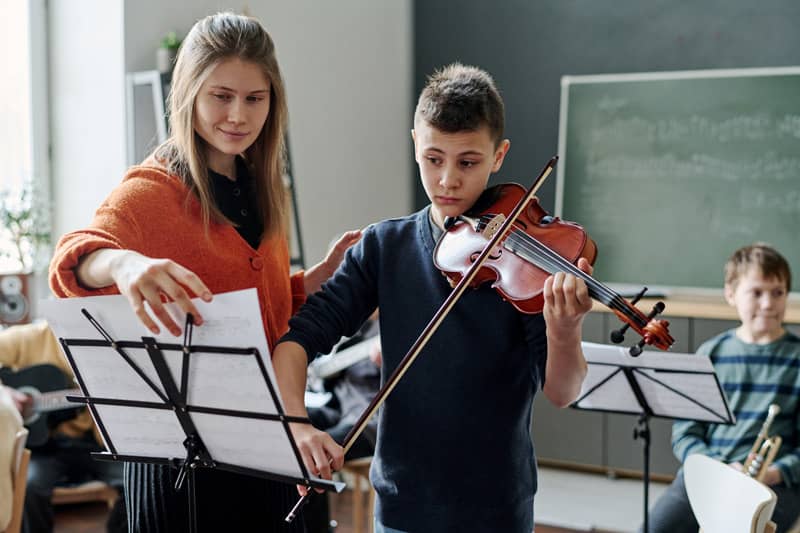
image of violin lesson Dublin - Dublin School of Music
Embark on Your Musical Voyage.

Ireland's vibrant culture of orchestral music finds a nurturing ground at the Dublin School of Music. Our programs prepare aspiring young musicians to join prestigious orchestral ensembles. Here, they forge lifelong friendships, create unforgettable memories, and enhance their musical prowess.

Examination Boards and Accreditation

We offer preparation for various grade examinations, including those from the RIAM Royal Irish Academy of Music, ABRSM the Associated Board of the Royal Schools of Music, Trinity Guild Hall and Sounds Great. If you have a specific examination board in mind, we can accommodate that as well - just let us know.
We blend music theory education with practical learning, preparing any student to progress confidently and challenge themselves. This approach offers many opportunities to play with other musicians, form lifelong friendships, and develop crucial musical skills.
Absolutely amazing school. It is my daughters 3rd year with Rachel at piano classes.The staff is great and Craig is always helpful!
Justyna
Google Review

Enrolment & Fees

Our enrolment is continuous and lessons are one-on-one, meaning you can start at any time.

Typically, we enroll by the term or for a year, with the fees based on a 10 lesson course over 10 consecutive weeks costing €300. Or, if you'd like to dip your toes in first, try a three lesson "taster course" at just €90. (If you decide to continue after your three lesson taster, the €90 will be deducted from the full fees).

We offer all students the opportunity to benefit from discounted fees by signing up to an automated payment plan this reduces the fees to €27.50 per lesson.

I know that the most joy in my life has come to me from my violin.

Albert Einstein

Our Violin Teachers

Dublin School of Music is an award-winning music school. 

Dublin School of Music’s faculty blends concert performers, examiners, composers, and seasoned educators, all united by a passion for nurturing talent. From first‑time beginners to diploma‑level musicians, our teachers tailor each lesson to the student’s goals and learning style.

You'll meet them in our teaching schools in Dublin - Tallaght, Stillorgan and Terenure.
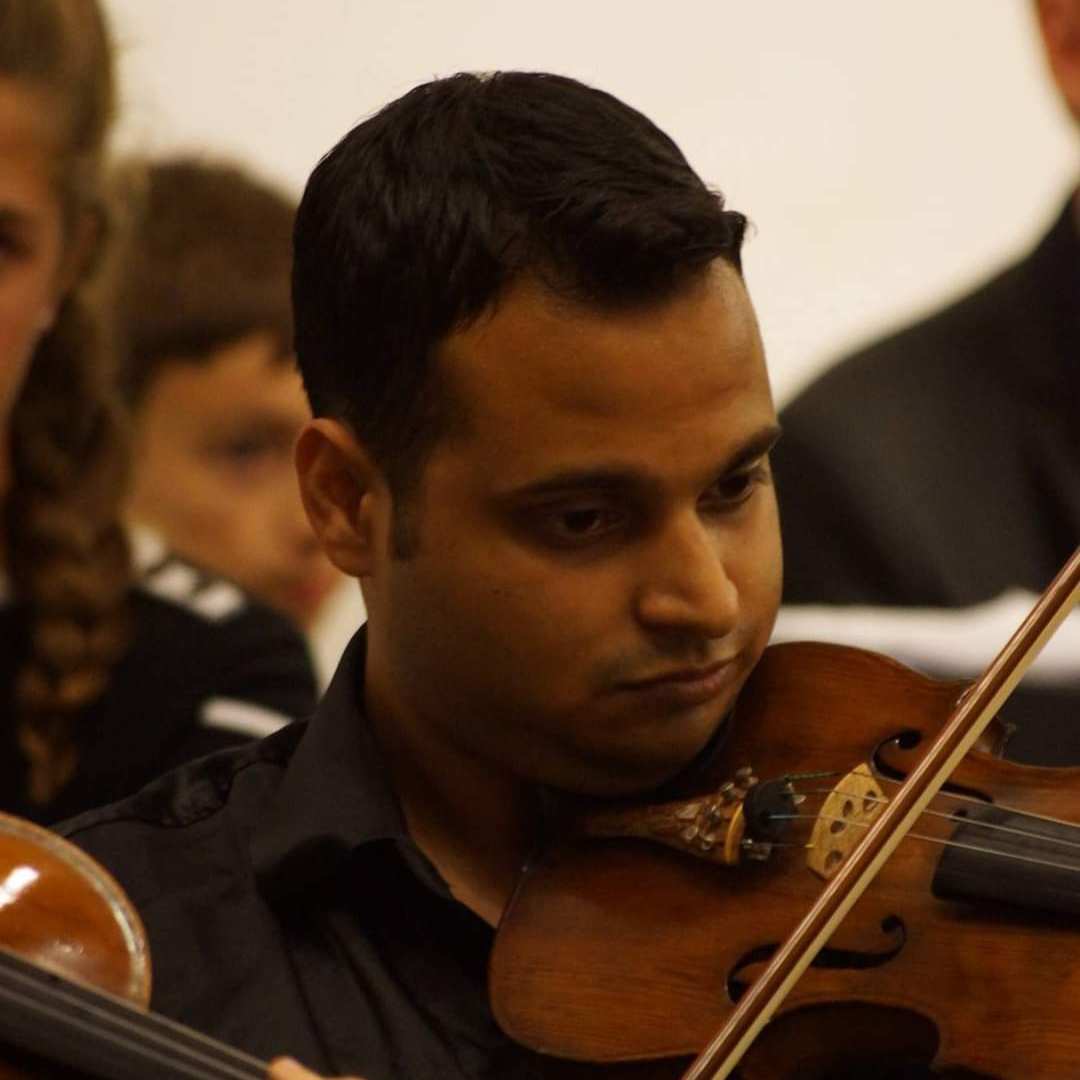
Aditya Mukherji
Violin

Adi is a classical trained musician from India, having completed his Masters in Classical String Performance from the University of Limerick under Kathrine Hunka from 2018-2020. He joined the Sing out with Strings teaching program in Limerick and continued with it till 2020 alongside teaching the Irish Chamber Youth Orchestra in Limerick.

After completing his Masters his first teaching job was at The Cavan Academy of Music at County Cavan where he taught young students and adults preparing them for examinations under ABRSM and RIAM. Afterwards he got several teaching jobs in Dublin, Ennis, Charleville and Limerick. He also acquired a Teaching Council license in 2022 and is in the panel of teachers for The Limerick and Clare Education and Training Board. He also has part time teaching hours at The Dublin School of Music in Tallaght and Terenure.

With regards to his performance experience, He has been playing with different orchestras since a very young age and was a part of different community orchestras ever since his visit to Ireland . For a while he did sub for the National Symphony Orchestra in Dublin. He also has his own ensemble called the Genie Ensemble where they merge different styles of music together creating something different with thier classical training.

Apart from music, Adi is heavily invested in his life away from music which includes Tango, West African Drumming and Dancing, Slow Waltz, Salsa and Bachata. He believes music and dance are co related and any child/adult can learn to incorporate both in their lives and be happy.
Aurora Vicente
Violin

Aurora is from Madrid, Spain but has been living and teaching music in Ireland for the last 20 years. Focusing primarily on the classical genre, she prepares students for the ABRSM/RIAM exams as well Junior and Leaving Cert. Aurora also loves teaching students who want to learn just for fun and enjoys working on pop, rock and jazz pieces.

Aurora graduated from the Superior Conservatory of Madrid with degrees in Piano (1998), Theory of Music and Accompaniment (1999) and Musicology (2002). She also an MLit in Irish Folklore (2007) from UCD.
Rohan Harron
Violin & Piano

Born in Yorkshire, Rohan Harron is a violinist and composer, currently studying at RIAM. As a performer, he has been a featured young artist with Hard Rain Soloist Ensemble, participated in the West Cork Chamber Music’s Fringe Festival and is the co-founder of the contemporary music ensemble ‘Outside the Lines’.

As a composer, he was the winner of the Milligan Fox Medal for his choral setting of ‘Weile, Weile, Weile’ for upper voices and also commissioned by Sing Ireland to write for the Irish Youth Training Choir as part of their ‘Unspoken Words, Unheard Voices’ project. In late 2023 was commissioned by Yorkshire Philharmonic Choir to write a string orchestra piece ‘From Dawn to Dusk’ to accompany Ola Gjeilo’s Sunrise Mass and his string quartet ‘Psychotia’, was performed by the Solas Quartet on their 2023 Irish tour and also at the National Concert Hall’s ‘Migrations’ String Quartet weekend in 2024.

Rohan has taught violin and piano at DSM since 2022
My daughters have been learning piano in Dublin school of music for the past couple of years. The standard of teaching is high and Craig is always pleasant to deal with and very accommodating with any changes in lesson times etc. Nina is a super piano teacher and both my daughters have learnt so much with her. We highly recommend this music school!
Lian O'Dwyer
Google Review, May 2021

The Violin: Common Questions

What people ask before they start, answered without the usual flannel.

Is violin very difficult to learn?

Yes, at the beginning — and the difficulty is front-loaded rather than spread out. This is the honest answer, and it is worth understanding why, because the reason also tells you when it gets easier.

A piano gives you the right note the moment you press the key. A violin has no frets and no keys, so your left hand must find the pitch itself while your right hand draws a bow across the string at the correct angle, speed and pressure. Two unfamiliar physical skills, both required at once, before you produce anything that sounds like music. That is the hard part, and it lasts roughly the first three to six months.

After that the curve flattens considerably. Once the bow is steady and the hand knows where the notes live, progress starts to feel like progress. Almost everyone who gives up does so inside the first few months — which is precisely the stretch where a teacher is worth most, because the specific thing making your sound scratchy is usually one correctable fault you cannot hear yourself.

Is a violin the hardest instrument to play?

It is the hardest of the common beginner instruments to get a decent sound out of. It is not the hardest instrument to play well — that is a different claim, and most players would hand it to the French horn or the oboe.

Ranked by how long before you sound acceptable to someone in the next room:

  • Easiest: ukulele, then piano — press and the note is correct.
  • Middling: guitar, drums — some physical setup, but quick rewards.
  • Hardest: violin, and the brass and woodwind family, where tone itself has to be built.

What the ranking hides is that difficulty and reward run together. The reason the violin is hard — that you control the pitch and the tone entirely yourself — is the same reason it can do things a piano cannot, including sliding between notes, swelling a single sustained note, and producing a vibrato that is recognisably yours. Players who stay with it tend to say the early struggle bought them something. If you would rather not fight an instrument for your first six months, piano or ukulele are the honest alternatives, and When Should My Child Start Music Lessons? sets out readiness instrument by instrument.

What is the Irish violin called?

The fiddle. It is the same instrument — a fiddle and a violin are physically identical, and a player can pick up either and play it. The word signals the tradition, not the object.

What differs is everything around the instrument. Classical violin playing is read from notation, uses a long sustained bow stroke and extensive vibrato, and sits inside an orchestra or an ensemble. Irish traditional fiddling is learned largely by ear, uses short crisp bow strokes with the ornamentation carried in the bow rather than the fingers, favours rolls and cuts over vibrato, and is played in sessions where everyone knows the tune. Some fiddlers do tune or set up the instrument differently, and bow grips vary by region — Donegal, Sligo and Clare playing are all distinguishable to an experienced ear.

Practically, the two are not a choice you have to make early. The left-hand accuracy and bow control you build in the first year serve both, which is why so many Irish fiddlers started with classical lessons and plenty of classical players can hold their own in a session. Our violin tuition covers classical repertoire and Irish fiddle alike — say which direction interests you when you enrol and we will match you with the right teacher.

How much does a decent violin cost?

For a beginner in Ireland, roughly €120 to €250 buys a usable student outfit — violin, bow, case and rosin together. Below about €100 you are usually buying something that will actively hinder you: pegs that slip, a bridge cut wrong, a bow that cannot hold tension. A cheap violin is not a smaller version of a good one; it is harder to play, which is the opposite of what a beginner needs.

Above that, the tiers run roughly as follows. €400 to €900 gets a step-up instrument with solid carved wood and noticeably better tone, which will carry a student through the graded exams. From about €1,500 upward you are into instruments worth keeping for life. The bow matters more than most beginners expect — a better bow on a modest violin often improves the sound more than the reverse.

Two practical notes. Children do not need an expensive instrument, because they will outgrow it: fractional sizes run from an eighth up to three-quarter, and most Dublin music shops will trade a size up as a child grows. Several also rent, typically for €20 to €30 a month, which is the sensible route if you are not yet certain the interest will hold. Ask your teacher before buying anything — ours will happily tell you whether a particular instrument is worth the money, which is a five-minute conversation that saves a good deal of regret.

How much do violin lessons cost in Dublin?

Private violin tuition in Dublin generally runs from €25 to €45 a lesson, varying with the teacher's background and the length of the slot. Violin is one instrument where group classes are a false economy — the entire early difficulty is physical setup, and a teacher cannot correct eight bow arms at once.

At Dublin School of Music, violin is taught one-to-one on a ten-lesson course at €300, which is €30 a lesson, reducing to €27.50 a lesson on our automated payment plan. A three-lesson taster course costs €90, and if you continue that €90 comes off your full fees — so trying it properly costs you nothing extra. Given how much of the first few months is down to physical habit, three lessons is genuinely enough to tell whether the instrument suits you.

Lessons run at Tallaght, Stillorgan and Terenure, and enrolment is continuous, so you are not waiting on a term to start. Full details are on our violin lessons page.

© Copyright 2026 Dublin School of Music. All rights reserved.
website designed and supported by WebBuddy.ie