
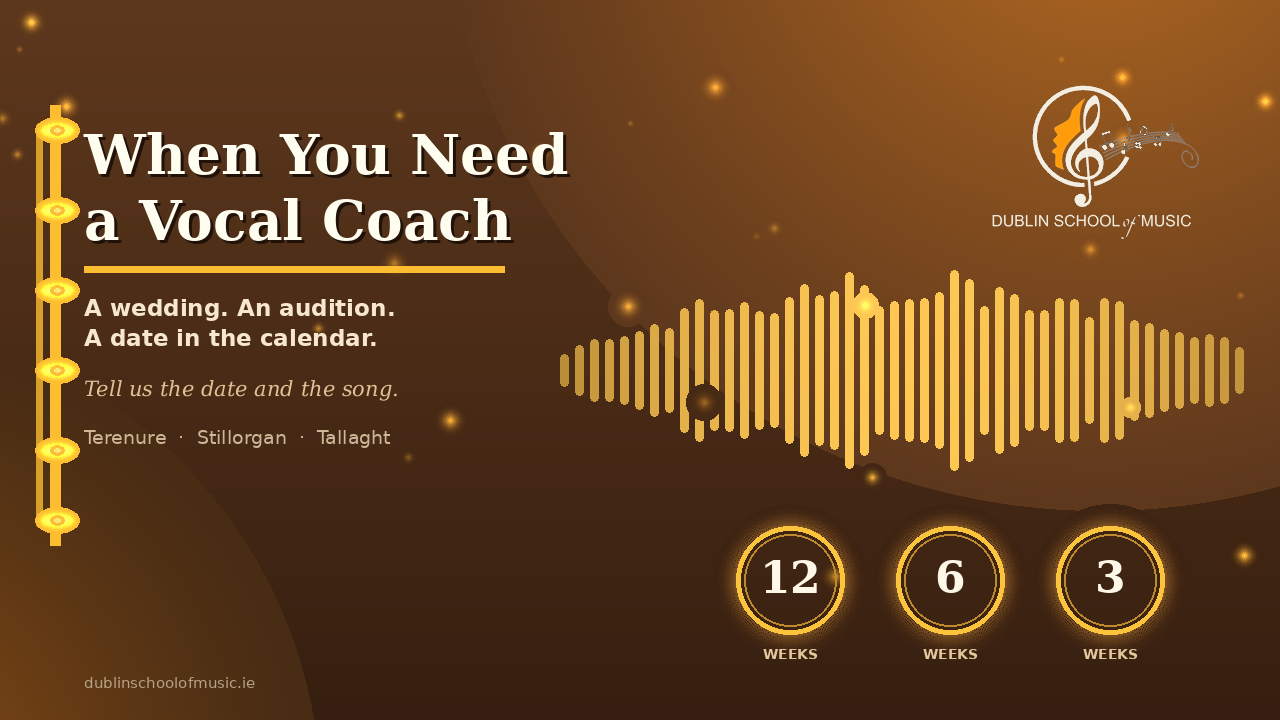
Three people walk into a music school in September. The first is getting married in twelve weeks and has promised — rashly, at 1am, to a delighted partner — to sing at the reception. The second has an audition for a musical in six weeks and a song they can almost, not quite, get through. The third fronts a band and has noticed that by the third song of every gig, their voice is gone.
None of these people are looking for singing lessons. They have a date in the calendar and a specific thing that has to happen on it. What they need is a vocal coach — and the difference between the two is worth understanding before you book either.
Singing lessons are open-ended. You come in, you build your voice over months and years, you sing things you love, and you get steadily better. That is a wonderful way to spend an hour a fortnight, and it is where most singers should start.
Coaching is different in one respect: it has a target. There is a song, a date, a room, and a standard that needs to be met on that date in that room. Everything in the sessions points at it. The technical work is chosen because it serves the performance, the repertoire is chosen because it suits both the voice and the occasion, and the schedule is built backwards from the day itself. Same teacher, same room, same thirty minutes — different job.
In practice, most singers do both. They take lessons to build a voice, and they shift into coaching mode when something specific appears on the horizon.
The work splits into two halves.
The technical half treats the voice as an instrument that can be adjusted. Breath support — the single biggest limiter on most untrained voices — is where it usually starts, because a phrase that runs out of air is not a talent problem, it is a mechanics problem. Then resonance, which is what makes a voice carry without shouting. Then the break between registers, that awkward gear-change most singers navigate by avoiding — a coach smooths it until the two halves of your voice sound like one instrument. Then range, extended carefully from the top and bottom of what you already have, and stamina, which is the answer to the third-song problem.
The preparation half is what surprises people. A great deal of coaching is not vocal exercise at all — it is decisions. Which song, out of the four you are considering? In which key — because the original key is the key that suited the original singer, and transposing down a tone is not cheating, it is what professionals do. Where do you breathe? Where does the song build? What do you do with your hands in bar one? What happens if the backing track fails, or the room is dead, or the microphone is too hot? A coach has stood beside enough performances to know what goes wrong, and to prepare you for the version of the day that is not the version in your head.
Twelve weeks or more. Comfortable. There is room for genuine technical development, not just preparation — the voice that sings on the day can be measurably better than the voice that walked in, not merely better rehearsed. If your date is this far out, start now rather than in eight weeks, because the technical work is the part that needs time.
Six weeks. Workable and common. Focus narrows to the song itself: key, breath placement, the two or three bars that keep collapsing, and enough repetition that the performance holds together under nerves. Technique improves as a by-product rather than a project.
Three weeks. Tight, but far from hopeless — and this is the one people wrongly assume is too late. Three weeks is enough to fix the key, secure the breathing, drill the difficult phrases, and rehearse the performance under pressure so that the nerves on the day meet something solid. What three weeks cannot do is build a new voice. It can absolutely make the existing one reliable.
The honest advice at any length: the earlier you start, the more of the work is improvement rather than damage control.
The wedding. The most common request we get, and the most emotionally loaded. You are singing to a room of people who know you, which is harder than singing to strangers, and you are doing it once. Coaching focuses on choosing a song that flatters your voice rather than the one you love most (sometimes they are not the same song), setting a key you can hit when your throat tightens with emotion, and rehearsing until muscle memory can carry you through a moment you may barely remember afterwards.
The audition or musical. Here repertoire choice is half the battle — the panel is assessing suitability as much as ability, and a song that sits perfectly in your voice says more than a difficult one that nearly works. Coaching covers cuts (sixteen bars, thirty-two bars), what to hand the accompanist, and how to walk into a room and start.
The band or the gig. Usually the stamina problem, occasionally the range problem. Singers who front bands are often self-taught, powerful, and burning through their voice by the third song because they are pushing from the throat rather than supporting from the breath. This is the most fixable problem in the article, and the improvement is often dramatic within a handful of sessions.
The Leaving Cert practical. Performance can be worth half the Leaving Cert Music result, and voice is an entirely valid instrument for the practical examination. Coaching here means choosing a programme that suits the student’s voice, preparing steadily across 5th and 6th year, and peaking in the spring of 6th year rather than in January.
Two honest limits.
A coach cannot manufacture a voice in a fortnight. If the ask is to sound like a different singer by a date three weeks away, the answer is no — what is achievable is to sound like a well-prepared version of yourself, which is usually what the room actually wants.
And if your voice is persistently hoarse, if singing hurts, or if your range has shrunk without explanation, that is a medical question before it is a technical one. A good coach will say so and suggest you see a doctor or an ENT specialist before doing more vocal work. Pain is not something to train through.
Vocal coaching at Dublin School of Music runs as one-to-one 30-minute sessions at our schools in Tallaght, Stillorgan, and Terenure. Our singing teachers are professional vocalists who work with wedding singers, audition candidates, band vocalists, musical theatre performers, and Leaving Cert students, as well as beginners with no particular destination in mind. Sessions are €300 for a ten-lesson term or €27.50 per lesson on our payment plan, and the three-lesson taster course is €99 — enough, in itself, to make a real difference to a performance three weeks away.
Tell us the date and the song. We will tell you what is possible between now and then.
Enquire about vocal coaching at Dublin School of Music.
Never had a singing lesson before? Here’s exactly what happens in a first one.