Every September, the same scene plays out in kitchens across Dublin. The decision to start music lessons has been made — that part was easy. And then comes the question that stalls everything: which instrument? Piano seems sensible, but the child keeps air-drumming on the furniture. Guitar looks fun, but is eight too young? The neighbour’s daughter does violin and it sounds lovely, though the neighbour has aged visibly. Somewhere between the options, weeks pass, and the enquiry never gets sent.
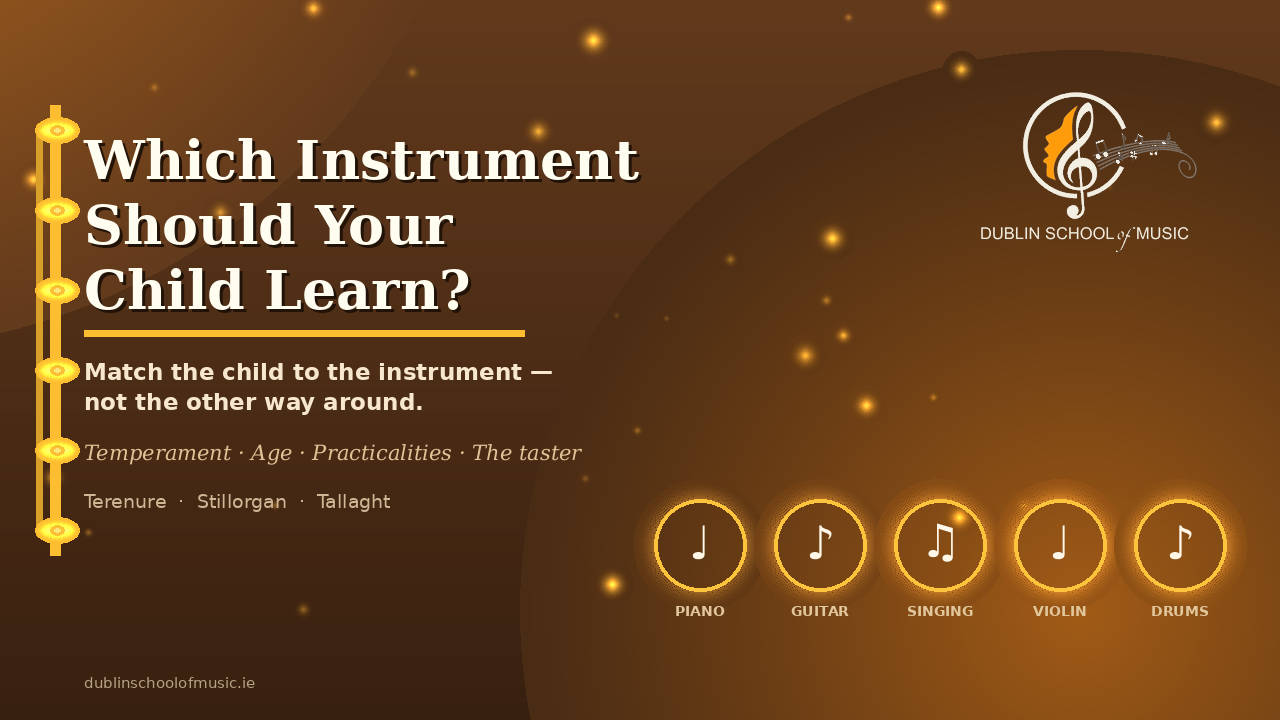
Here is the reframe that unsticks the decision: stop asking which instrument is best, and start asking which instrument fits this child. Instruments have personalities. So do children. The match matters more than any ranking — and reading your child is something you are already the world’s leading expert at. This guide covers the temperaments, the ages, the practicalities, and what to do if you are still torn at the end.
The child who cannot sit still. The one who drums on the table, the car dashboard, their own knees — who seems to experience music as movement. That child is telling you something. Drums channel physical energy into rhythm, coordination, and focus, and the transformation of a restless child behind a kit is a thing to behold. Rhythm is also the foundation every other musician envies later.
The child who sings in the car. Unprompted, unselfconscious, word-perfect on songs nobody taught them. The voice is already their instrument — lessons simply train it. Singing suits the expressive child, the performer, the one who feels music rather than studies it. And it requires no purchase, no storage, and no reminder to bring it to the lesson. If nerves are the worry, here is exactly what a first singing lesson involves.
The patient, precise child. The one who finishes the Lego set, who likes doing things properly, who does not mind that good things take time. The violin rewards exactly this temperament. It is the most demanding beginner instrument — there are no frets, and the early weeks are an act of faith — but the child suited to it develops an ear, a discipline, and eventually a sound that belongs to them alone.
The child who wants to play songs they know — soon. Guitar delivers recognisable music faster than almost anything else: a few chords unlock hundreds of songs. It suits the child motivated by results, the one who wants the music in their life to be the music they play. The trade-off is a physically uncomfortable first few weeks while fingertips toughen — worth warning them about, and worth pushing through. If you’re wondering about readiness, here’s how to tell — and for smaller hands not ready at eight, the ukulele is a genuine instrument in its own right and a perfect bridge.
The thinker. The child who likes puzzles, patterns, and understanding how things work. Piano lays music out visually — every note in a row, low to high — and teaches melody, harmony, and theory simultaneously. It is the instrument on which music makes sense, which is why it remains the default recommendation for a first instrument and the foundation from which every later instrument becomes easier. And here’s what a year of piano actually delivers.
And beyond the big five, the wider woodwind and string family — flute, clarinet, saxophone, bass — tends to suit slightly older beginners, and often makes a wonderful second instrument once foundations are in place.
Readiness is partly physical. Piano and violin can begin at four or five — small hands manage both, and scaled-down violins exist for exactly this reason. Singing and drums work from around seven, when vocal and motor development are ready for training. Guitar generally waits until about eight, when hands can manage the neck and fingertips can build calluses. These are guidelines rather than laws; the better test is whether your child can focus for fifteen minutes on something they enjoy and shows genuine curiosity about music. A child pushed in at four gains little over the child who starts, delighted, at six. Here’s our full guide to starting ages.
Noise. The drum question every parent asks silently: what about the neighbours? The honest answer is that practice kits have improved beyond recognition — modern electronic kits and practice pads make home practice entirely civilised, and headphones do for drums what they long ago did for keyboards. Which is the second point: a digital piano with weighted keys and headphones means piano practice at any hour, in an apartment, without a single complaint. Noise is a solved problem for both of the “loud” instruments.
Cost of the instrument itself. Starter instruments are more affordable than most parents fear: a playable beginner guitar, a scaled violin, or a ukulele all come in well under the cost of a games console, and a solid digital piano is a one-off purchase that lasts a decade. Voice, famously, is free. There is no need to buy anything before the first lesson — wait until the instrument is settled, and ask the teacher for a specific recommendation before spending a euro.
The sibling question. Two children on the same instrument invites comparison; two children on different instruments invites a band. Where a genuine preference exists, honour it — but there is quiet magic in a household that ends up with a pianist and a drummer.
The single strongest predictor of whether a child practises is whether they chose the instrument. Motivation outperforms every theoretical advantage — a child excited about guitar will progress faster on guitar than a reluctant child on the “sensible” piano, every time. So give the choice real weight. The parent’s role is to set the frame: age-appropriate options, practical realities named, and then genuine freedom inside that frame. If their choice surprises you, good. It usually means it was really theirs.
One reassurance for the parent worried about choosing wrong: there is no wrong. Every instrument teaches rhythm, pitch, discipline, and the experience of getting better at something difficult. A child who starts on piano and moves to guitar at eleven has lost nothing — the foundations travel. The only genuinely bad outcome is the one where the decision was never made at all.
If it is a coin-toss between two instruments, here is the tiebreak, in order. First: which one does the child talk about? Second: if truly neutral, piano — its visual logic and theoretical foundation make every future instrument easier. Third: stop deciding and start testing. Our three-lesson taster course exists for exactly this moment — €99, three lessons on the instrument of their choice, and if they continue, the €99 comes off the term fees. Three lessons tells you more than three months of kitchen-table deliberation ever will. And if the first instrument turns out to be the wrong one, that is not failure; that is information, gathered cheaply.
At Dublin School of Music we teach piano, guitar, singing, violin, drums, flute, clarinet, saxophone, bass, ukulele and more — all one-to-one, thirty minutes, at our schools in Tallaght, Stillorgan, and Terenure. Lessons are €300 per ten-week term or €27.50 per lesson on our payment plan, and the €99 taster course is the gentlest way to turn “which instrument?” into an answer. Tell us about your child — the air-drumming, the car singing, the Lego — and we will happily help you match them. It is one of the best parts of the job.
Enquire about children’s music lessons at Dublin School of Music.