Almost everybody who picks up a guitar has the same picture in mind. It is not a stage, or an exam certificate, or a scale played cleanly at speed. It is a room, a few people, and a song everyone knows, with you as the one holding it together. Some people get there in a year. A great many never do, not for lack of talent but because they spent that year alone with a laptop, learning the wrong things in the wrong order and quietly deciding they were not musical after all.
Our guitar lessons in Dublin exist to close that gap. Dublin School of Music teaches acoustic, electric, classical and bass guitar one-to-one, to children from six or seven and to adults of every age and level, at our three schools in Tallaght, Stillorgan and Terenure. Every lesson is with a specialist guitar teacher, every week, built around the music you actually want to play. What follows is an honest account of how that works, what it costs, and what you can expect, so that you can decide whether it is right for you or your child before you spend a cent.
There has never been more free guitar instruction in the world, and there have never been more half-learned guitars sitting in Irish bedrooms. Those two facts are connected.
A video can show you where to put your fingers. It cannot see where you actually put them. It cannot notice that your thumb has crept over the top of the neck, that you are pressing three times harder than you need to, or that your strumming hand stops every time your fretting hand changes chord. None of these feel like problems at first. Each one becomes a ceiling a few months later, and by then the habit is set and the student has concluded that the instrument is simply hard.
A teacher sees those things in the first five minutes, and fixes them while they are still cheap to fix. That is most of the value in the first year.
The second thing a teacher gives you is sequence. Self-taught players tend to collect techniques at random, wherever the algorithm takes them, and end up with a strange patchwork: a flashy riff, no rhythm, three chords they can play and twenty they cannot get to in time. A teacher decides what comes next, and why, so that every week builds on the last. We have written about this pattern at length in Why You Stopped Teaching Yourself Guitar, and if you recognise yourself in it you are in very good company.
The third is less technical and just as important. A weekly lesson is an appointment with somebody who will know whether you practised. Nearly every adult who comes back to the guitar after giving up tells us the same thing: the motivation was never the problem; the structure was.
"Guitar" covers four related but distinct instruments, and the right starting point depends on the music that made you want to play.
Acoustic guitar is where most of our students begin. You learn open chords, strumming patterns and simple fingerpicking, and you reach real songs remarkably quickly, because a handful of chord shapes opens up hundreds of them. It is the instrument of the singer-songwriter, the session in the kitchen and the campfire, and it is the most forgiving place to build the basic coordination every other style depends on.
Electric guitar covers rock, blues, pop, indie and metal. Lessons move into lead technique, riffs, the scales that soloing is built on, bending and vibrato, and learning to improvise over a backing track. The electric is often easier on the fingers than the acoustic, because the strings are lighter, which makes it a perfectly sensible first instrument for anyone whose heart is in that music. Starting on acoustic "because you should" is a rule more people repeat than follow, and we would rather you start on the guitar you will actually pick up.
Classical guitar is played with nylon strings and the fingers rather than a pick, and it puts more weight on reading music, fingerstyle technique and graded repertoire. It suits students who love that sound, those heading towards the formal exam route, and younger children, for whom nylon strings are gentler. We teach it as its own discipline; see our classical guitar lessons.
The bass builds groove, timing and the foundation every band depends on. It is a quietly brilliant choice for anyone who loves to play with other people, and good bass players are always in demand. See our electric bass guitar lessons.
Whichever you choose, the lessons are shaped around the music you want to play rather than a fixed syllabus. If you want to understand what the instrument gives back over time, beyond the songs, What Guitar Teaches That Nothing Else Does makes that case.
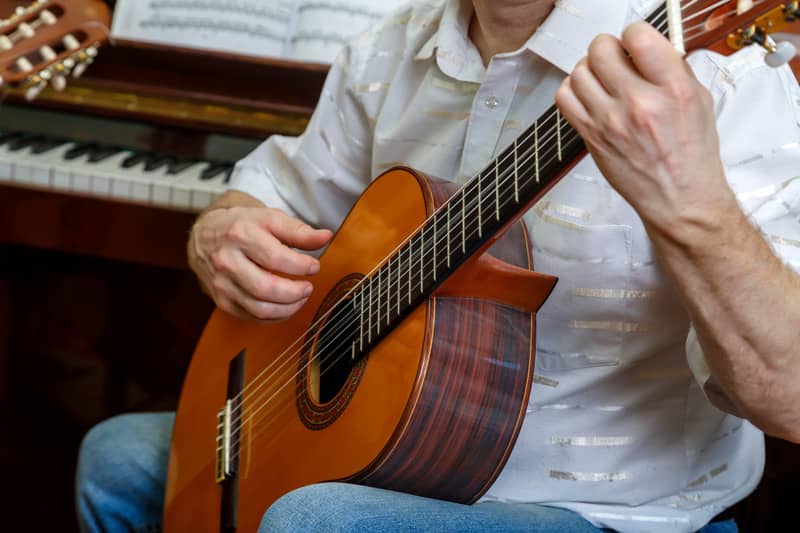
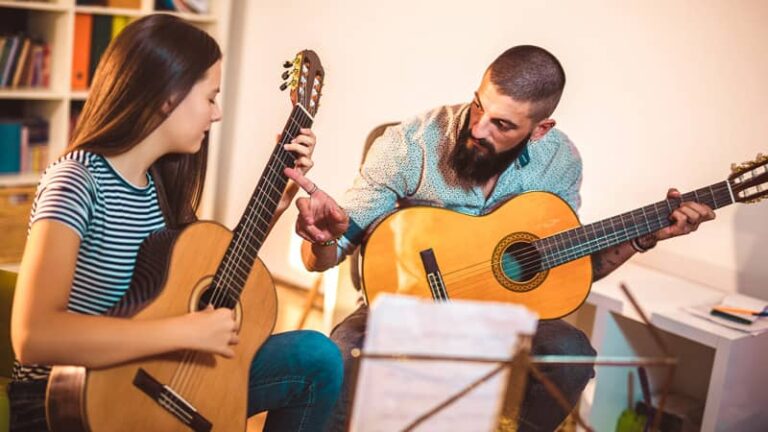
Children can begin guitar lessons with us from six or seven. The limits at that age are physical rather than musical: a guitar asks small hands to press thin strings firmly against a fretboard, and the instrument has to be the right size for the child. A smaller guitar, a quarter or half size, with nylon or light strings, makes an enormous difference. Get the instrument wrong and a young beginner spends the first month fighting it; get it right and the same child is playing recognisable tunes within weeks.
The better question is whether your child is ready, and readiness has less to do with age than parents expect. A child who can sit and attend for the length of a lesson, follow a two-step instruction, and cope with a little discomfort in the fingertips while the calluses form is ready. A child who cannot will usually do better waiting a few months than being pushed through it. We set out the signs in Is My Child Ready to Start Guitar Lessons?, and compare instruments for younger children in Which Instrument Should Your Child Learn?
Children make progress in proportion to what happens between lessons, and between lessons is your territory. That does not mean supervising every minute or knowing anything about the guitar. It means a regular, short practice time, a guitar left out of its case where it can be picked up, and interest in what they are learning rather than how long they spent. Ten minutes most days will beat an hour on Sunday every time.
Teenagers tend to arrive with a list of songs and a band in mind, and we teach to both. Guitar can also be taken as the performing instrument for Leaving Cert Music, where steady weekly lessons make the practical component far less daunting. The Leaving Cert Music Guide explains how the course works.
A large share of our guitar students are adults, and a good number of them are beginning for the first time in their forties, fifties or later. They are rarely slower than teenagers. Adults understand why a technique matters, they practise with intent, and they choose the music they learn, which means they actually want to play it. The physical demands of guitar are modest at any age; the sore fingertips of the first fortnight are the same at fourteen as at sixty, and they pass.
Then there are the returners: people who had lessons as children, or taught themselves at nineteen, and put the guitar away when life got busy. Most of them assume they have forgotten everything. Most of them are wrong. The hands remember more than the head expects, and the first few lessons are usually spent clearing away old habits and finding out how much was still there. We have written about why so many adults come back, in Why Adults Who Gave Up Music Keep Coming Back, and for anyone considerably past forty, Starting at Sixty.
The usual worry is time. Adults with jobs and families do not have an hour a day, and they do not need one. Fifteen focused minutes, most days, on the thing your teacher set will move you further than a long weekend session spent playing what you already know. Part of the teacher's job is making sure those fifteen minutes go on the right thing.
Finally, the player who has been at it for years on their own and stopped improving. This is one of the most satisfying students to teach, because the problems are usually specific and fixable: a fretting-hand habit, a rhythm that drifts, a gap in theory that makes everything feel like memorisation. A few months of lessons can undo years of plateau. If you want a sense of what is realistic from a standing start, What Can You Play After a Year of Guitar Lessons? gives an honest month-by-month account.
The first lesson is a conversation as much as a lesson. Your teacher will want to know what made you want to play, what you listen to, and whether you have played before, and will then put the guitar in your hands within the first few minutes. Many complete beginners leave their first lesson able to play two chords and the change between them. It does not sound like much until you realise that two chords is enough for a surprising number of songs.
For children, the first lesson also checks the fit of the instrument, the posture and the hand position, because these set the pattern for everything that follows.
You will need your own guitar. Dublin School of Music does not rent instruments, so it is worth sorting one out before the first lesson. It does not need to be expensive, but it does need to be playable: correctly sized for a child, with strings that sit low enough to the fretboard to press down without a fight. A cheap guitar that is badly set up is the single most common reason beginners give up early, and it is entirely avoidable. Bring the guitar, a tuner or tuning app on your phone, and a pick if you are playing acoustic or electric. Your teacher will take care of the rest.
Exams are entirely optional. Some students thrive on a clear target, a date in the diary and a certificate at the end of it; others would rather spend every lesson on the music they love, and both are perfectly good ways to learn the guitar.
For those who want them, we prepare students for graded exams with RIAM, ABRSM, Trinity College London, Sounds Great and RGT, across acoustic, electric and classical guitar, with the board chosen to suit the student and the style. A grade usually takes between six months and a year of steady weekly lessons, depending on the level and the practice behind it, and we would rather a student sat an exam well prepared than early. Graded exams also give younger students a structured path towards Leaving Cert Music, where performance carries real marks.
We teach guitar at all three of our schools. Lessons are one-to-one, so the location is simply whichever suits your week.
Our Tallaght school is at Units 15/16 Old Bawn Shopping Centre, Old Bawn, Dublin 24, D24 R1XA, convenient for Old Bawn, Firhouse, Knocklyon, Ballycullen, Citywest and Kingswood. See music lessons in Tallaght.
Our Stillorgan school is at 20 Kilmacud Road Lower, Stillorgan, Dublin 18, A94 F9K8, serving Stillorgan, Kilmacud, Mount Merrion and the surrounding south Dublin suburbs. See music lessons in Stillorgan.
Our Terenure school is at Eaton House, 86–88 Terenure Road North, Dublin 6W, D6W VY73, a short trip from Rathgar, Rathmines, Harold's Cross, Kimmage, Templeogue and Rathfarnham, where the school began in 2003. See music lessons in Terenure.
My daughter has been taking guitar lessons here for years. The teaching is fantastic and she absolutely loves it, and they have been very accommodating with class times, changes etc. Can't recommend them highly enough.
Guitar lessons are one-to-one, thirty minutes long, once a week. Fees are based on a ten-lesson term at €300, which works out at €30 a lesson. Students who sign up to our automated payment plan pay €27.50 a lesson instead.
If you would rather try before committing, our three-lesson taster course costs €99, and if you continue, the €99 comes off your full fees, so the trial costs you nothing extra. Enrolment is continuous: you can start any week of the year rather than waiting for a term to begin. To book a taster or ask a question, enquire here or call us on (01) 492 9998.
Dublin School of Music has many guitar teachers across its three schools. Between them they cover acoustic, electric, classical, jazz and bass guitar, and most teach more than one instrument, which is a real advantage for a young student still finding their way. We match each student to a teacher by the style they want to play and the way they like to learn.

The Dublin School of Music is the perfect place for young kids to explore and develop their love for music. The teachers are not only highly skilled but also multi-instrumentalists, which has been an incredible advantage for my 5-year-old. He has the luxury of trying different instruments—guided by expert instruction—until he finds the one he truly connects with.
The school’s warm, old-worldly charm, combined with a thoughtful and flexible teaching approach, creates a nurturing environment where children can flourish. They make learning fun and engaging while building a solid foundation in music. I highly recommend it for any parent looking for a personal, enriching musical education for their child!
The questions we are asked most often by people thinking about starting.
You can learn a great deal of guitar in three months. With weekly lessons and short, regular practice, most beginners can play the main open chords, change between them in time, strum steadily and get through a handful of recognisable songs. What three months will not give you is fast barre chords or fluent lead playing; those come later in the first year.
For most students, yes. A focused 30-minute one-to-one lesson each week gives a teacher time to check technique, correct problems and set the week's practice, and it matches what a beginner can absorb before concentration fades. Progress depends far more on fifteen minutes of practice most days than on a longer lesson once a week.
No. Adults in their forties, fifties and beyond make up a large share of guitar students, and many progress faster than teenagers because they practise with intent and choose music they love. The physical demands of guitar are modest at any age, and the sore fingertips of the first fortnight pass just as quickly at forty as at fourteen.
If you have tried on your own and stalled, almost certainly. Free videos show you what to play but cannot see your hands, so faults in fretting, posture and rhythm go uncorrected and become the limit on your progress. A teacher spots those in minutes and decides what you should work on next, which is the part self-teaching rarely gets right.
Private guitar lessons in Dublin generally cost between €25 and €45 a lesson. At Dublin School of Music, one-to-one guitar lessons are €300 for a ten-lesson term of weekly 30-minute lessons, or €27.50 a lesson on our automated payment plan. A three-lesson taster costs €99 and is deducted from your fees if you continue.
Most children can start guitar lessons at six or seven. At that age the main limits are physical: small hands need a correctly sized guitar, usually a quarter or half size with nylon or light strings. Readiness matters more than the exact age; a child who can concentrate for a short lesson and follow simple instructions is ready to begin.
Yes. You will need your own guitar for lessons and for practice at home; Dublin School of Music does not rent instruments. It does not need to be expensive, but it should be the right size and properly set up, with strings low enough to press down comfortably. A badly set-up guitar is one of the most common reasons beginners give up.
Start on the guitar that plays the music you want to play. Electric guitars have lighter strings and are often easier on the fingers; acoustic guitars need no amplifier and suit songs and strumming. Classical guitars, with soft nylon strings, suit young children and anyone drawn to fingerstyle music. The skills transfer between all three.
The best way to find out whether guitar is for you, or for your child, is three lessons with a teacher who knows what they are doing. Book a three-lesson taster at Tallaght, Stillorgan or Terenure for €99, deducted from your fees if you carry on. Book online below or call (01) 492 9998.